“He will wipe away every tear from their eyes, and death shall be no more, neither shall there be mourning, nor crying, nor pain anymore, for the former things have passed away.””
— John · Revelation 21:4
HIGH · EVIDENCE GRADEFACTUAL RECORD
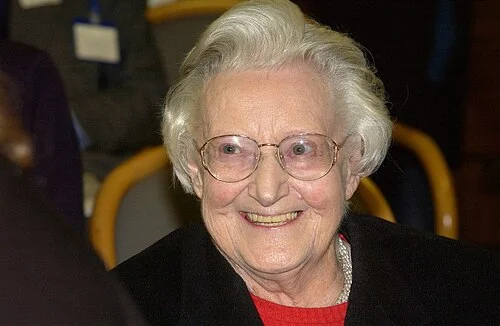
Cicely Saunders — a Christian convinced that every dying person matters — founded the modern hospice movement (St Christopher's, 1967).
Cicely Saunders — founder of the modern hospice
Image credit & licence
CC BY-SA 4.0 · History of Modern Biomedicine Research Group
A social worker turned physician, and a Christian, Cicely Saunders built the modern hospice on one sentence she said to a dying patient: you matter because you are you. Palliative medicine — now a mainstream specialty in every hospital system — began as an act of explicitly Christian care for the dying, in one building in South London.
EVIDENCE VS. COUNTERFACTUAL
This label distinguishes a factual historical record from the interpretation built around it. A well-documented event or influence pathway does not prove that no alternative history could produce a similar result. Grade note: the influence pathway is well documented; replacement remains a separate question
STRONGEST OBJECTION(S)
Palliative medicine would likely have emerged from medicine's own failures; that it emerged first as a Christian act of care is the documented part.
The causal chain — tap (i) for detail
01You matter because you are you — Saunders' founding principle Saunders’s approach treats a dying patient as a person whose experience still matters when cure is no longer possible. Pain, fear, relationships and dignity therefore remain proper concerns of care. The principle changes the question from whether treatment can defeat the disease to what can still be done for the person living with it.
02St Christopher's Hospice, 1967 St Christopher’s Hospice opened in 1967 as a setting for organised care of the dying. Bringing relief of suffering together with sustained attention to patients created an institutional model others could study and adapt. The particular foundation matters to the movement’s history, without implying that no compassionate care for dying people existed beforehand.
03Palliative care enters mainstream medicine Palliative care spread through training, research, services and changes in professional expectations. Its adoption in wider healthcare extended the concern beyond a single hospice and beyond patients with a particular religious affiliation. Christian motivation belongs to Saunders’s history, while the clinical discipline can serve people with many beliefs and differing wishes about end-of-life care.PRESENT DAY