
Without Jesus
Case WJ-X-02 · Branch 2 of 2
THE ATLAS›X · SCIENCE & TECHNOLOGY›THE PRINT ENGINE

The Print Engine

ENGLISH STANDARD VERSION (ESV)

“And the gospel must first be proclaimed to all nations.”

— Jesus · Mark 13:10
HIGH · EVIDENCE GRADEFACTUAL RECORD

Gutenberg's Bible was one of the landmark early European printed books; Christian textual demand was important to the early print market.
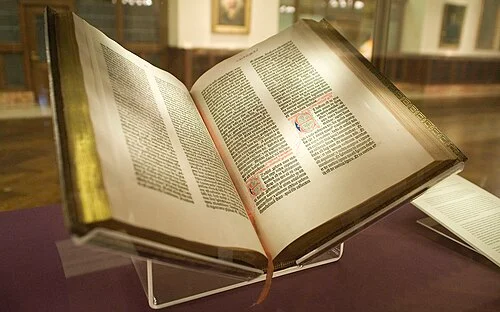
The Gutenberg Bible, c. 1455
Image credit & licence

NYC Wanderer (Kevin Eng) · CC BY-SA 2.0 · originally posted to Flickr as Gutenberg Bible

Original image and licensing

Gutenberg's 42-line Bible, printed around 1454–55, is a landmark in the history of European printing and demonstrates the importance of religious texts in the early print market. The Bible was not the only driver of the technology: craft knowledge, capital, commercial demand and earlier printing traditions in East Asia belong in the wider history. Once established, European print culture helped carry religious controversy, scholarship, science and literature.

Religious demand was one important market for early printing, but the claim that one book alone made the press viable is too strong without further economic evidence.

EVIDENCE VS. COUNTERFACTUAL

This label distinguishes a factual historical record from the interpretation built around it. A well-documented event or influence pathway does not prove that no alternative history could produce a similar result. Grade note: the influence pathway is well documented; replacement remains a separate question

STRONGEST OBJECTION(S)

Commerce printed once the presses existed; the initial demand — the market that made the machine viable — was overwhelmingly the Book.

The causal chain — tap (i) for detail
01The demand: cheap, accurate texts of Scripture Biblical and liturgical texts created an important book market in Christian Europe, where manuscript production was costly. This made reliable reproduction attractive. Religious demand was one motive among several; a full history includes craft skills, capital, other readers and earlier printing traditions elsewhere in the world.
02Gutenberg's 42-line Bible (c. 1455) Gutenberg’s 42-line Bible, produced around the middle of the fifteenth century, is a landmark of European printing. Its scale and execution show what new workshop methods could accomplish. It demonstrates religious publishing’s importance without establishing that Scripture alone made printing viable or that this was the first printed object.
03Print explodes across Europe As printing workshops spread, texts became easier to reproduce and circulate on a growing scale. Religious controversy was one important use alongside scholarship, administration and literature. The consequences varied, so the change should be followed through actual printers and readers rather than imagined as an instantaneous revolution everywhere.
04The knowledge economy begins Printed books and later journals supported new forms of learning and communication. They depended on readers, commercial networks and institutions capable of preserving and using information. Christian publishing belongs to this development, while the knowledge economy has many technological and social ancestors beyond the history of one printed Bible.
Modern concepts — what it becomes
The 42-Line Bible→Print Meets a Reading Faith→
Encounter the Gospel invitation →