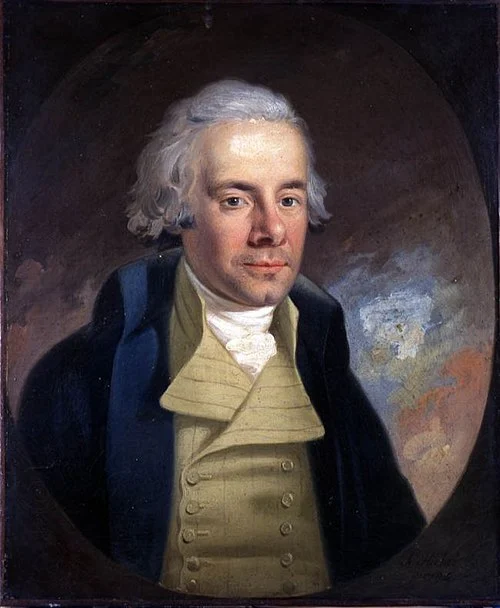
Drove the abolition of the British slave trade (1807) and slavery (1833) through a forty-six-year parliamentary campaign run on explicitly evangelical conviction — while other Christians defended the trade with the same Bible. Both facts are part of his record.
William Wilberforce — the forty-six-year campaign
Image credit & licence
Anton Hickel · Public domain · originally uploaded to en.wikipedia by Agendum (talk · contribs) on 4 November 2007, 14:53 under the file name William wilberforce.jpg.(+/−)
The record, plainly: his reformation-of-manners campaigns supported policing of the poor that reads badly today, and he moved slower on factory conditions than on slavery. The ledger keeps him — whole.
EVIDENCE VS. COUNTERFACTUAL
This is an interpretive synthesis: the sources support elements of the story, but the overall causal weight remains open to historical debate. Grade note: the influence pathway is well documented; replacement remains a separate question
The causal chain — tap (i) for detail
01Evangelical conversion (1785) Wilberforce's evangelical commitment altered his account of public duty and helped sustain his attention to reform. The evidence concerns his own stated priorities and continuing work rather than the dramatic form of a conversion anecdote alone. It explains an important motivation while leaving room to examine the political interests and limitations that also shaped his career.
02God Almighty has set before me two great objects — diary, 1787 His statement of two great objects placed opposition to the slave trade alongside a programme of moral reform. Those aims should be understood in their own eighteenth-century setting rather than assumed to match all modern reform priorities. The declaration matters because it gives direct evidence of how he described the religious purpose of his public life.
03The parliamentary campaign, 1787–1833 Parliamentary action depended on allies, research, petitions, public pressure and political opportunities across many years. Wilberforce provided a prominent voice within that movement, not its entire organization. Enslaved people's resistance and the work of Black and white abolitionists belong in the same history, which cannot be reduced to one legislator's persistence.
04Slave Trade Act 1807 · Slavery Abolition Act 1833 The 1807 act targeted the British slave trade, while the 1833 legislation addressed slavery in much of the British Empire through an unequal settlement that included major exclusions and delayed freedom. Wilberforce died before the latter act became law. Distinguishing these outcomes prevents a moving biographical ending from obscuring what Parliament actually enacted and when.
05The template of faith-driven reform Later reformers could draw encouragement from a campaign sustained by religious conviction and organized political work. Its methods included cooperation among people whose beliefs and roles differed. The example is influential without being the origin of every faith-based movement, and its success should be assessed alongside the compromises and injustices retained in the settlement.