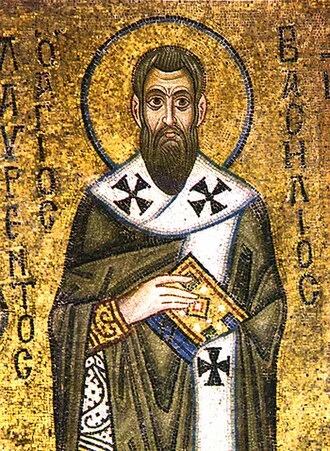
“I was naked and you clothed me, I was sick and you visited me, I was in prison and you came to me.’”
— Jesus · Matthew 25:36
HIGH · EVIDENCE GRADE
Founded the Basileias at Caesarea (c. 369) — the first famous hospital complex: wards, physicians, a leper section, no payment. The institutional ancestor of the modern hospital.
Basil of Caesarea
Image credit & licence
Public domain · http://www.sedmitza.ru/index.html?sid=883&did=49554&p_comment=belief
The record, plainly: he was also a hard-line theologian who pressed an emperor and hounded heretics in his see; the hospital and the combative bishop were the same man.
EVIDENCE VS. COUNTERFACTUAL
This is an interpretive synthesis: the sources support elements of the story, but the overall causal weight remains open to historical debate. Grade note: the influence pathway is well documented; replacement remains a separate question
The causal chain — tap (i) for detail
01I was sick and you looked after me — Matthew 25 Basil's concern for the sick and poor drew on Christian teaching that receiving vulnerable people was a duty toward Christ. This supplied a reason to organize care beyond immediate family obligations. The theological motivation can be identified without claiming that Christians invented compassion or that earlier societies had no institutions for assistance.
02Basil preaches wealth as trusteeship His preaching challenged wealthy hearers to regard possessions in relation to their neighbours' needs. Such exhortation helped turn giving into a matter of responsibility rather than a purely discretionary favour. The next historical question is how that principle acquired a durable form, since even forceful sermons do not by themselves provide beds, staff or treatment.
03The Basileias, c. 369 — buildings, physicians, the poor, lepers The charitable complex associated with Basil brought different kinds of assistance into an organized setting near Caesarea. Accounts of its work show religious leadership connected with practical provision for people who were sick or poor. Calling it an ancestor of later care institutions is useful, provided its functions are not simply equated with those of a modern general hospital.
04Later canon and imperial law spread the model Later Christian foundations and legal arrangements helped make organized care a repeatable institutional undertaking. The form varied as patrons, bishops, communities and governments adopted different responsibilities. This stage concerns the spread and stabilization of provision, rather than assuming every later hospital copied Basil's buildings or followed a single unchanged administrative plan.
05The hospital as a civic default Modern hospitals emerged through many additional developments in medicine, staffing, finance and public authority. Basil's foundation belongs among the earlier institutions through which Christians organized assistance, giving the broader history a significant religious strand. That genealogy is stronger when particular links are documented than when one ancient institution is credited with the whole modern system.
Sources
§Gregory of Nazianzus, Oration 43 — an eyewitness description · ENTRY REVIEWED 2026-10-02T1 · PRIMARY