“But I say to you, Love your enemies and pray for those who persecute you,”
— Jesus · Matthew 5:44
HIGH · EVIDENCE GRADE
A pastor's son who dismantled American segregation law with the Sermon on the Mount as strategy and Scripture as constitution — nonviolence as Christian obedience, not tactic.
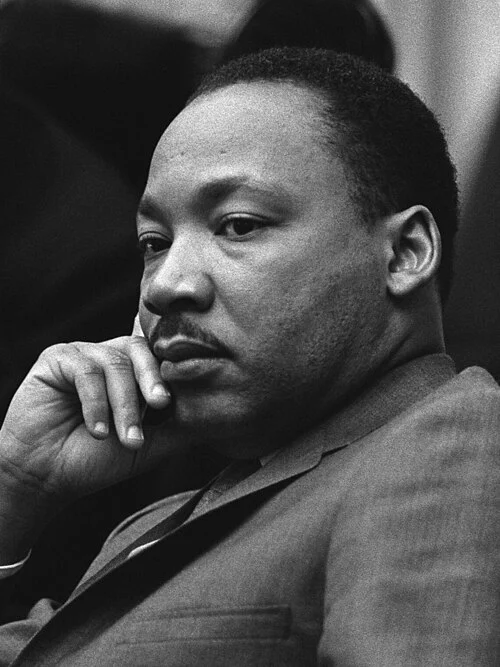
Martin Luther King Jr.
Image credit & licence
Yoichi Okamoto · Public domain · Lyndon Baines Johnson Library and Museum. Image Serial Number: A2133-10. http://photolab.lbjlib.utexas.edu/detail.asp?id=1083
The record, plainly: his personal failings are documented by his own associates and by the government that spied on him. The movement's moral force came through a flawed man, like most men in this hall — the Letter from Birmingham Jail quotes Aquinas on just law while the FBI taped the hotel rooms; both are the record.
EVIDENCE VS. COUNTERFACTUAL
This is an interpretive synthesis: the sources support elements of the story, but the overall causal weight remains open to historical debate. Grade note: the influence pathway is well documented; replacement remains a separate question
The causal chain — tap (i) for detail
01The Black church as his formation King's formation within the Black church joined biblical preaching, community leadership and an inherited struggle against racial injustice. Education and encounters with other thinkers, including Gandhi, also shaped his approach. The religious foundation is direct and well documented, but it operated within a wider intellectual and organizational world rather than supplying every element in isolation.
02Montgomery (1955–56); the pulpit as strategy The Montgomery boycott relied on sustained community participation, organizing and alternative transport as well as speeches from the pulpit. Churches supplied meeting places, trusted networks and a language of perseverance. King's leadership mattered within that collective effort, which translated a local grievance into a practical challenge to segregation through coordinated action.
03Letter from Birmingham Jail (1963): just law as God's law The Birmingham letter answered religious critics by connecting immediate protest with arguments about justice, law and moral responsibility. Biblical references and Christian thinkers formed part of its reasoning, alongside American political ideals. The document shows religious language being used to challenge delay and institutional caution rather than simply reinforcing established authority.
04The March on Washington; the Civil Rights Act (1964) The March on Washington made demands for jobs and freedom visible through a large coalition, with King's speech becoming one lasting expression of its hopes. Federal civil-rights legislation followed wider organizing, protest and political negotiation. The connection is real, but neither the march nor the law should be attributed to a single speaker or sermon alone.