“and what you have heard from me in the presence of many witnesses entrust to faithful men, who will be able to teach others also.”
— Paul · 2 Timothy 2:2
HIGH · EVIDENCE GRADEFACTUAL RECORD
Harvard College (1636) was founded to train a learned ministry — dreading, in the words of its own first public pamphlet (1643), to leave an illiterate ministry to the churches.
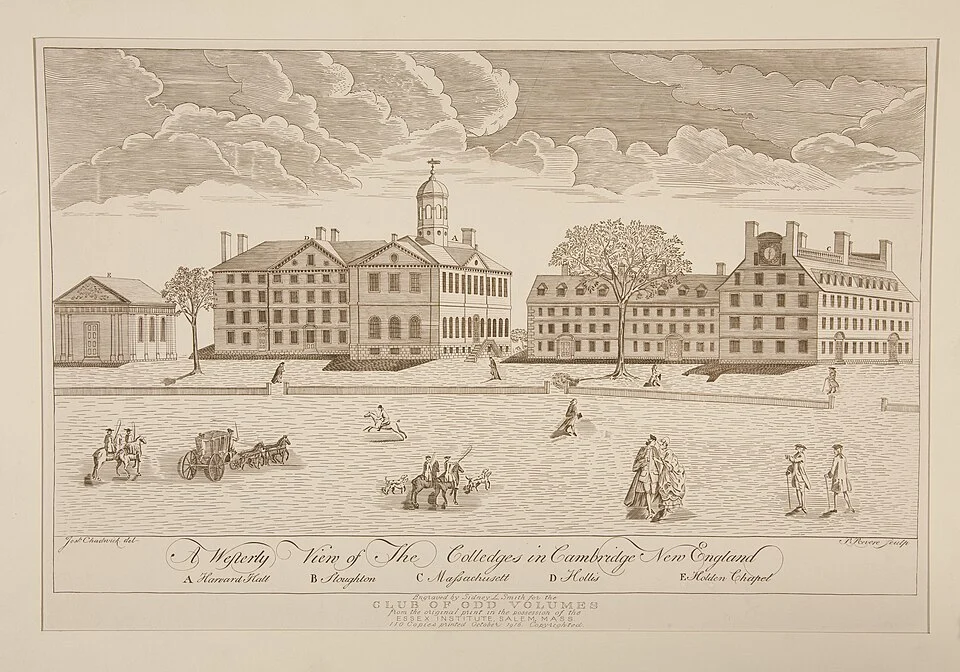
Harvard — founded 1636 for a learned ministry
Image credit & licence
Paul Revere · Public domain · Yale University Art Gallery
The colony's first college printed its reason for existing in a 1643 pamphlet: after God had kept us from the wilderness, it said, one of our next concerns was “to advance learning and perpetuate it to posterity; dreading to leave an illiterate ministry to the churches.” The sentence survives because the pamphlet does.
EVIDENCE VS. COUNTERFACTUAL
This label distinguishes a factual historical record from the interpretation built around it. A well-documented event or influence pathway does not prove that no alternative history could produce a similar result. Grade note: the influence pathway is well documented; replacement remains a separate question
STRONGEST OBJECTION(S)
The founding generation's literacy goals served a colony's needs too; piety and practicality shared the motive, and both are documented.
The causal chain — tap (i) for detail
01The Massachusetts colony's stated need The Massachusetts colonists wanted learning to continue across generations and regarded an educated ministry as an urgent communal need. That setting helps explain the decision to establish a college despite the difficulties of colonial settlement. The religious purpose was a significant part of the project, not a claim that every future graduate would become a minister.
02Founding and early statutes (1642/1646) Early collegiate rules placed Christian learning and Scripture within students’ daily studies. These arrangements show how the founders’ purpose entered the institution’s teaching practices rather than remaining a general aspiration. They should be distinguished from Harvard’s later curriculum and governance, which changed considerably as the college developed into a modern university.
03The aim printed in New England's First Fruits (1643) New England’s First Fruits publicly explained the educational undertaking in 1643. Its concern about leaving churches without a learned ministry is direct evidence of the institution’s early rationale. The pamphlet is therefore useful as a contemporary statement of purpose, rather than as proof that the same purpose describes every subsequent period of Harvard’s history.PRESENT DAY
Sources
§New England's First Fruits (1643) — the primary pamphlet, digitized · ENTRY REVIEWED 2026-10-02T1 · PRIMARY