“Knowing their thoughts, he said to them, “Every kingdom divided against itself is laid waste, and no city or house divided against itself will stand.”
— Jesus · Matthew 12:25
VERY HIGH · EVIDENCE GRADEFACTUAL RECORD
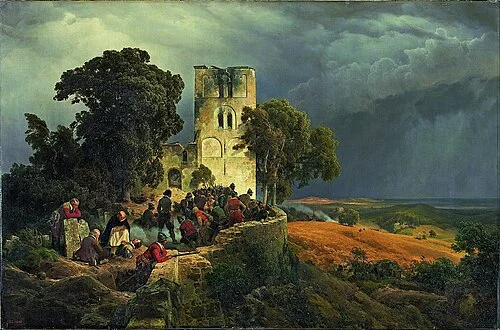
Catholics against Protestants, confession against confession — Europe tore itself apart, and the Thirty Years' War left some regions a third empty.
The Thirty Years' War — Europe torn apart
Image credit & licence
Karl Friedrich Lessing · Public domain · 1wEqeIJ6E-zN8w at Google Cultural Institute maximum zoom level
After the Reformation, princes chose their subjects' confessions and armies enforced the choice — culminating in the Thirty Years' War, which left some German regions with a third of their people dead and Europe with a permanent horror of confessional war. The church that taught one Lord fought itself with burning villages.
The peace that ended it, Westphalia (1648), invented the modern state system largely to cage the churches — the political architecture of the modern world was built, in part, as a fence against Christian war. The objection's context is real: princes used confessions as chess pieces. The bodies were real too.
EVIDENCE VS. COUNTERFACTUAL
This label distinguishes a factual historical record from the interpretation built around it. A well-documented event or influence pathway does not prove that no alternative history could produce a similar result. Grade note: the historical record and pathway are especially well established
CONTEXT
The context: princes used confessions as chess pieces, and the peace that ended the wars (Westphalia, 1648) invented the state system partly to cage the churches. The war was religious the way a bar fight is about a chair.
The causal chain — tap (i) for detail
01Reformation fractures Christendom The Reformation changed religious allegiance and authority within societies where church and political order were closely connected. Disagreement could therefore become a struggle over territory, law and obedience as well as belief. Religious conviction was significant, while dynastic interests and political calculations also shaped the conflicts.
02Religion by prince — cuius regio, eius religio The principle associated with a ruler’s religion placed confessional choices within a framework of territorial power. It was a limited political arrangement, not modern freedom of conscience for every individual. Its importance lies in how authorities tried to contain conflict while retaining substantial control over the religious lives of their subjects.
03The Thirty Years' War (1618–48) The Thirty Years’ War combined confessional, dynastic and strategic conflicts across shifting alliances. Its suffering included displacement, hunger and disease as well as battle deaths. Calling it simply a war of religion can obscure those interacting causes, but removing religion from the account would also distort the historical setting.
04Westphalia: the churches caged inside states The settlements of 1648 addressed particular political and confessional disputes rather than creating a complete modern system of religious liberty at once. Their importance should be understood through the arrangements they actually established. Later toleration and constitutional limits developed through further struggles, arguments and changes in state power.